
Our Theory of Change
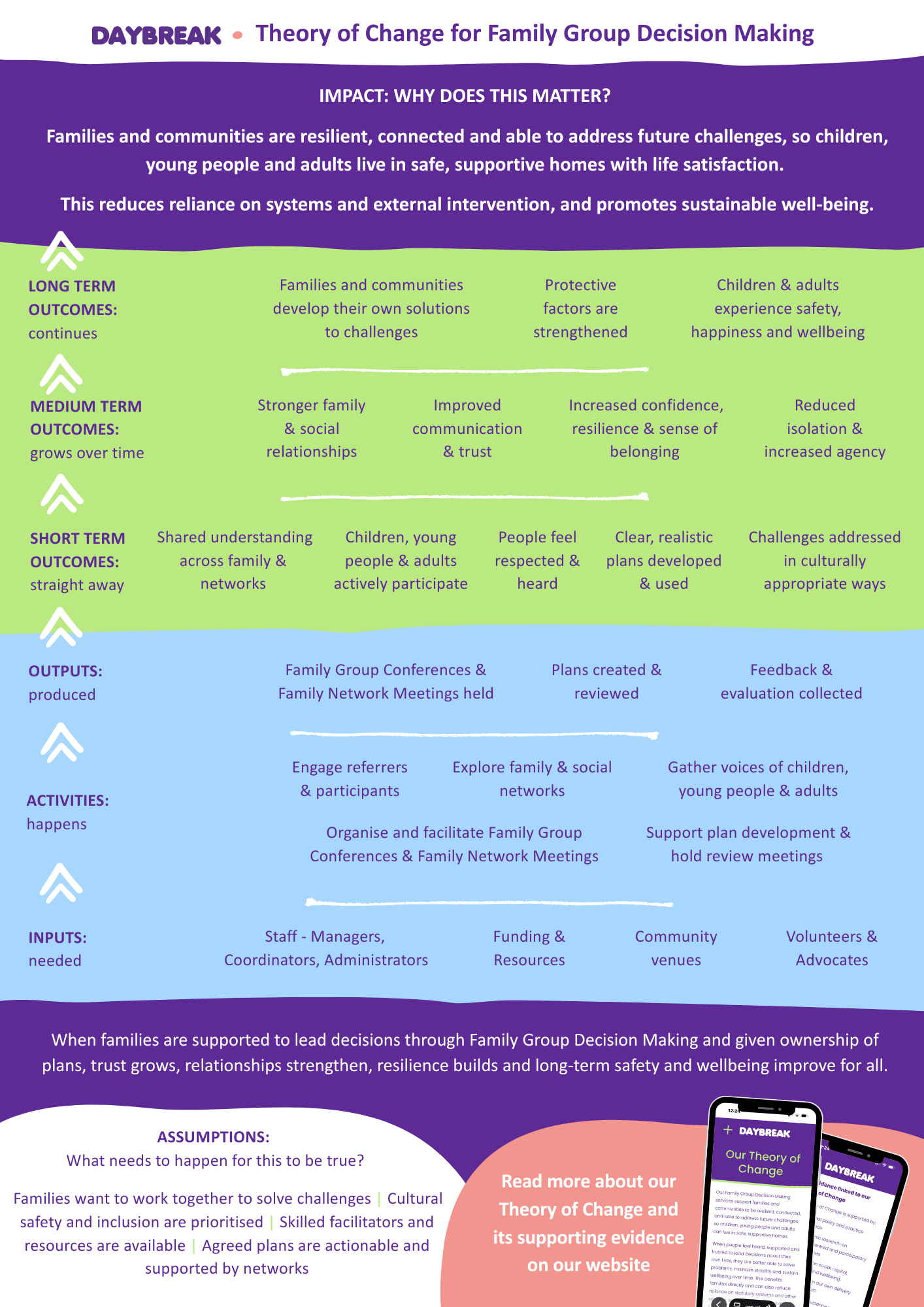
Our Family Group Decision Making services support families and communities to be resilient, connected, and able to address future challenges, so children, young people and adults can live in safe, supportive homes.
When people feel heard, supported and trusted to lead decisions about their own lives, they are better able to solve problems, maintain stability and sustain wellbeing over time. This benefits families directly and can also reduce reliance on statutory systems and other services, such as Children’s Social Services.
Our Theory of Change explains how our Family Group Decision Making services create this impact, and what needs to be in place for it to happen.
You can download our Theory of Change infographic for a simple visual overview, or keep reading to learn more about the rationale and evidence behind our approach.
What is a Theory of Change?
Our Theory of Change explains the difference we are trying to make, what needs to happen to achieve it, how our work supports this change, and the assumptions our approach relies on. We use it to help our partners and funders understand why we work in the way we do, and how our services are designed to make a lasting difference for families and communities.
It follows a recognised structure setting out the key inputs (the things we use), activities (the things we do) and outputs (the things we create) and the eventual short, medium and long term outcomes that result from this work.
Our Theory of Change, explained.
We are working towards a world where families and communities are resilient, connected, and able to address future challenges, so children, young people and adults can live in safe, supportive homes. When this happens, families are supported and the need for external or statutory services is reduced over time.
What long-term changes are we seeking?
In the long term, families and communities have the knowledge, skills and confidence to develop their own solutions to challenges. They feel empowered, and their problem‑solving skills strengthen. As a result, they experience increased protective factors in their lives (for example, XYZ), and children, young people and adults can experience safety, happiness and positive wellbeing.
These long‑term changes support stability and resilience, helping families address future challenges before they escalate into crisis.
How is resilience built over time?
In the medium term, families build stronger family and social relationships, improve communication and trust, and experience increased confidence, a stronger sense of belonging, and greater agency.
Evidence shows that these qualities of connectedness are closely linked to resilience and wellbeing.
What changes straight away?
The immediate, short‑term outcomes of our work lay the foundations for these longer‑term shifts by creating a positive experience of decision‑making and support.
Children, young people and adults actively engage in the process and feel respected and heard. This helps develop a shared understanding of a situation across the family and wider network, making it possible to create realistic, actionable plans that can be put into practice.
As a result, challenging situations can be addressed positively and in culturally appropriate ways that reflect individuals’ strengths and family contexts.
These early changes in understanding, attitudes and behaviour set the stage for deeper change. Evidence shows that when people are actively involved in decisions that affect their lives, they feel more satisfied, have greater ownership of plans, and are more likely to see them succeed.
What does this involve?
To do this, Family Group Conferences and Family Network Meetings (both models of Family Group Decision Making) are facilitated, plans are created and later reviewed, and feedback and evaluation is collected. These are the key outputs of our services for each family.
To do this, we
Engage referrers, families and their wider networks.
Explore family and social support networks.
Gather voices of all involved, including children and young people
Organise and facilitate Family Group Conferences and Family Network Meetings.
Develop and circulate family-led plans.
Hold review meetings, when relevant.
This structured, evidence‑based process increases participation and supports the creation of high‑quality, realistic plans.
What makes this work possible?
To deliver this work effectively, we rely on our skilled staff team (Programme Managers, Coordinators and Administrator support), funding and practical resources, accessible community venues, and volunteers and advocates to support our work and those we work with.
Our assumptions
It is important to acknowledge that our Theory of Change relies on the following assumptions being true:
families want to engage in collaborative problem‑solving
cultural safety, sensitivity and inclusivity are maintained
trained facilitators and adequate resources are available
plans developed through Family Group Conferences and Family Network Meetings are realistic and supported by family and community networks
Our core logic
Overall, when families are supported through structured Family Group Conferences and Family Network Meetings and given ownership of plans, they build trust, strengthen relationships, and develop resilience, leading to long-term safety and well-being for all members.
Key evidence linked to our Theory of Change
Our Theory of Change is supported by:
national policy and practice guidance
academic research on family‑centred and participatory approaches
evidence on social capital, resilience and wellbeing
learning from our own delivery and evaluation
A summary of key evidence is below. For more detailed research and publications on Family Group Decision Making, visit our Policy & Research Hub.
Department for Education (2023) Families First Partnership Programme
The Families First Partnership Programme sets out a national framework for reforming children’s social care through early intervention, multi-agency collaboration, and Family Group Decision Making (FGDM). It emphasises empowering families to take ownership of plans and solutions before formal proceedings, aiming to reduce reliance on statutory services. The programme supports safeguarding partners in embedding FGDM across systems of help and protection, reinforcing the value of family-led decision-making in achieving sustainable outcomes.
This peer-reviewed editorial explores the intersection of domestic abuse and child safeguarding, advocating for integrated, family-centred responses. It highlights the importance of engaging families in safety planning and decision-making to ensure long-term protection and wellbeing. The authors argue that participatory approaches, including Family Group Conferencing, can improve compliance and outcomes by respecting the lived experiences of families and fostering trust between professionals and service users.
This report presents qualitative research from local authorities implementing the Supporting Families programme. It finds that whole-family working, facilitated by keyworkers and coordinated plans, leads to improved engagement, reduced escalation, and better outcomes. The study underscores the importance of involving families in decision-making processes, noting that consent-based, relational approaches increase trust and effectiveness. It also identifies barriers to engagement and offers strategies for reaching harder-to-engage families. A report on the programme is also accessible: Department for Levelling Up, Housing and Communities (2024) Supporting Families Annual Report.
Children’s Commissioner for England (2023) Stability Index.
The Stability Index tracks placement, school, and social worker changes for children in care, revealing that instability undermines wellbeing and long-term outcomes. The report highlights how stable relationships and environments—often achieved through family-led planning and early intervention—are critical to resilience. It calls for systems that support continuity and empower families to participate in decisions that affect their children’s lives, reinforcing the need for inclusive and proactive safeguarding practices.
Office for National Statistics (2020) Social Capital in the UK
This analysis defines social capital across four domains: personal relationships, social support networks, civic engagement, and trust. It finds that strong social ties and cooperative norms are linked to higher wellbeing and resilience. The report supports the Theory of Change’s emphasis on strengthening family and community networks, showing that connectedness enhances individuals’ capacity to cope with challenges and reduces isolation.